
Business Card Printing in Australia: Everything You Need to Know Before You Order
Discover how to get the most from business card printing in Australia — from paper stocks and finishes to design tips and bulk ordering advice.

Written by
Claire Bassett
Stationery & Office
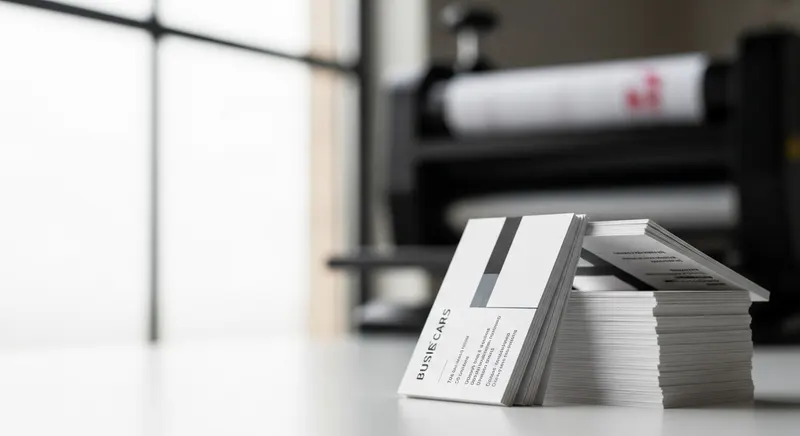
First impressions happen fast — and in a professional setting, your business card is often the very first tangible representation of your brand that someone holds in their hands. Despite living in an increasingly digital world, business card printing remains one of the most enduring, cost-effective branding investments an Australian business, marketing team, or sports club can make. A well-designed, high-quality card communicates professionalism, attention to detail, and brand confidence in a matter of seconds. But with so many options available — from paper stocks and finishes to printing methods and turnaround times — knowing where to start can feel overwhelming. This guide breaks it all down so you can order with clarity and confidence.
Why Business Card Printing Still Matters in 2026
It might seem old-fashioned to talk about printed cards when LinkedIn profiles and digital wallets exist, but the reality is quite different on the ground. At trade shows in Melbourne, networking events in Sydney, or client meetings in Brisbane, physical business cards are still exchanged constantly. They create a tactile, memorable moment that a digital connection simply cannot replicate.
For marketing teams, business cards are a low-cost branding asset that keeps your logo, contact details, and brand identity circulating long after an initial conversation. For sports clubs — think a Canberra football association or a Gold Coast surf club — a printed card adds professionalism when approaching sponsors or welcoming new members. The humble business card punches well above its weight.
There’s also an important consistency argument. When your cards align with your broader branded collateral — your custom tote bags, your branded stationery items, your event signage — they reinforce a coherent visual identity that builds trust over time.
Understanding Business Card Printing Options
Paper Stock: The Foundation of Quality
The paper you choose sets the tone for everything else. Standard business cards are typically printed on cardstock ranging from 300gsm to 400gsm. The higher the GSM (grams per square metre), the thicker and more substantial the card feels. For most professional applications, 350gsm is a solid all-rounder.
Beyond thickness, you’ll encounter several key paper stock types:
- Coated gloss – Vibrant, high-shine finish; ideal for full-colour designs with photography or bold imagery
- Coated matte – A smooth, non-reflective surface that feels premium and sophisticated; great for writing on
- Uncoated stock – Natural, tactile feel; popular for eco-friendly or craft-style brands
- Recycled stock – An excellent choice for brands prioritising sustainability; pairs well with sustainable promotional products in your broader merchandise strategy
Finishes and Special Effects
Once you’ve chosen your base stock, the real fun begins. Finishes and special effects are where business card printing goes from functional to genuinely impressive.
Spot UV applies a glossy coating to specific design elements — a logo, a tagline, a pattern — while leaving the rest of the card matte. The contrast is striking and adds a tactile dimension.
Foil stamping uses metallic foils (gold, silver, rose gold, holographic) pressed onto the card under heat. It’s an elegant choice for premium brands, luxury real estate agents, or financial services firms wanting to make a statement.
Soft-touch lamination gives the card a velvety, luxurious feel that’s become increasingly popular for corporate applications. It photographs beautifully and feels noticeably premium in the hand.
Embossing and debossing raise or indent specific design elements, adding dimension and a craft-quality feel. These techniques work especially well with minimalist designs where the texture can really shine.
Rounded corners are a small but effective touch that makes cards feel more contemporary and less generic.
Printing Methods Explained
Understanding the actual printing process helps you make smarter decisions:
Digital printing is the most common method for standard business card printing. It’s fast, cost-effective for short runs, and delivers excellent colour accuracy. Turnaround times as quick as 2–3 business days are achievable with digital printing.
Offset printing suits larger runs where colour accuracy and consistency are paramount. The setup cost is higher, but the per-unit price drops significantly at volume. If your Melbourne-based company is ordering 5,000+ cards across a sales team, offset makes financial sense.
Letterpress printing is a heritage technique that presses ink deeply into thick, uncoated stock. The result is tactile, artisanal, and genuinely beautiful — though it comes at a premium price point.
Design Considerations for Business Card Printing
Getting Your Artwork Right
Poor artwork is the number one cause of print delays and disappointing results. Before you submit files, keep these essentials in mind:
- Resolution: Supply artwork at a minimum of 300dpi. Screen-resolution images (72dpi) will print blurry or pixelated.
- Colour mode: Convert all files to CMYK. RGB colours are for screens and will shift when printed — sometimes dramatically.
- Bleed and safe zones: Include a standard 3mm bleed around all edges. Keep critical text and logos at least 3–5mm from the trim line.
- File formats: PDF (print-ready) and AI files are widely preferred. High-resolution JPEG or PNG files are usually accepted as secondary options.
For teams managing visual design elements across multiple branded touchpoints, it’s worth building a style guide that standardises fonts, colour codes, and logo usage before submitting to print.
Standard and Non-Standard Sizes
The standard Australian business card size is 90mm × 55mm. It’s industry-standard for a reason — it fits neatly into cardholders and wallets. That said, non-standard sizes are increasingly popular for brands wanting to stand out:
- Square cards (55mm × 55mm) – Memorable and creative
- Landscape cards (90mm × 55mm, horizontal layout) – Classic and practical
- Mini cards (85mm × 45mm) – Compact and quirky; popular with creatives
- Folded cards – Effectively double-sided, offering more real estate for content
Quantities, MOQs, and Pricing
How Many Should You Order?
Business card printing typically becomes significantly more cost-effective at volume. While some suppliers offer runs as low as 25–50 cards for individuals, most professional-quality printers set a minimum order quantity (MOQ) of 100–250 cards.
For a team of ten sales staff at a Sydney tech company, ordering 500 cards per person in a single bulk run makes far more financial sense than ten separate orders of 50. Per-card costs can drop by 60–70% when scaling from 100 to 1,000 units.
Consider your realistic distribution timeline. If you’re attending three trade shows in Adelaide and Perth over the next six months, order enough to cover that period rather than scrambling for rush reprints between events.
Budget Planning
For standard 350gsm cards with digital printing, expect to pay roughly $40–$80 for 250 cards. Premium finishes like soft-touch lamination, spot UV, or foil stamping will add cost — budget $80–$200+ for 250 cards depending on the complexity.
For large-scale corporate orders (5,000+ cards), per-unit costs can fall well below $0.05 per card on straightforward designs. Always request a formal quote before committing, and check whether setup fees, GST, and freight are included.
Turnaround Times and Rush Orders
Standard turnaround for digital business card printing in Australia typically runs 3–5 business days from artwork approval. Express options (1–2 business days) are usually available at a surcharge. Freight adds time — account for 1–3 additional business days for deliveries to regional areas in Queensland, Western Australia, or the Northern Territory.
Plan backwards from your event or campaign launch date, factoring in proof approval time. A printed proof is always worth requesting for first-time orders or new designs — catching an error at proof stage costs far less than reprinting 500 cards.
Pairing Business Cards with Your Broader Branded Collateral
Business cards work hardest when they’re part of a cohesive branded ecosystem. If you’re preparing for a conference or trade show, consider how your cards complement your other branded materials and giveaways — from branded promotional USB drives on your exhibition table to custom tote bags for attendees, or even branded sticky notes at your display.
For sports clubs heading into sponsorship season, coordinating business cards with supporter merchandise like event wristbands or slap-on wristbands for game days reinforces a unified brand presence that impresses potential sponsors.
Seasonal gifting is another opportunity to integrate cards thoughtfully. Whether you’re sending winter branded gifts to suppliers or loading up a conference bag with branded goodies, a well-presented business card tucked into the package adds a personal, professional touch. Similarly, branded umbrellas ordered for a corporate event pair naturally with a card holder or branded cardholder envelope.
Don’t overlook the workplace either. Complementing your cards with tape dispensers and other desk accessories carrying your branding creates a consistent office environment that impresses visiting clients.
Key Takeaways
Wrapping up, here’s what to keep in mind when approaching business card printing for your business, marketing team, or sports club:
- Invest in quality materials — paper stock, finish, and print method all contribute to how your brand is perceived. A flimsy card undermines an otherwise strong brand.
- Prepare print-ready artwork — supply files in CMYK at 300dpi with correct bleed to avoid costly reprints and delays.
- Order at sensible quantities — bulk business card printing delivers significant cost savings; plan your volumes around realistic distribution timelines rather than ordering the bare minimum.
- Factor in the full timeline — from artwork approval to freight, business card printing projects typically need 5–10 business days; rush jobs are possible but cost more.
- Integrate cards into your wider brand strategy — business card printing is most effective when it’s part of a consistent, well-considered branded collateral suite that tells a cohesive story about your organisation.